Vibe coding has taken enterprise IT by storm, creating a sharp divide inside organizations.
Developers love the speed: describe an internal tool in natural language, let AI generate code, and spin up a working prototype in minutes. IT leaders, however, face the operational hangover: Where is customer data stored? Which systems can this app touch? What happens when its builder leaves? And is sensitive CRM data leaking to external AI models?
This tension now defines vibe coding in enterprise software development. While generic code generators excel at rapid prototyping, they struggle with long-term governance, CRM connectivity, and enterprise security.
To solve this, Alaio Vibecode by Bitrix24 introduces a dedicated workspace environment designed to turn natural-language prompts into secure, durable, and production-ready enterprise applications.
What is vibe coding for business?
Vibe coding for business is the practice of using natural-language prompts and Large Language Models (LLMs) to build internal applications, workflow automations, and custom AI agents. In enterprise environments, it combines prompt-driven development with strict data governance, scoped permissions, managed infrastructure, and native CRM integration so generated software operates safely beyond the prototype stage.
In 2026, natural language app development is rapidly replacing legacy IT backlogs. Maintaining enterprise-grade governance is now the primary competitive differentiator.
Why standalone vibe coding fails and how Alaio Vibecode solves it
Standalone AI coding tools generate code in a vacuum. When an application needs live customer records, sales pipelines, or automated workflows, developers must build complex API bridges, manage external hosting, and expose credentials.
Alaio Vibecode solves this by bringing natural-language app building straight into Bitrix24. Instead of managing third-party hosting or exposing raw database credentials, applications execute within secure, sandboxed environments under scoped permissions. By combining native CRM data access, isolated workspace execution, and pre-built prompt patterns, teams can safely automate core business processes under strict zero-data retention policies.
Comparing vibe coding frameworks
| Capability | Standalone AI Generators | Alaio Vibecode (Enterprise-Integrated) | Traditional Low-Code |
|---|---|---|---|
| Development Speed | Very High | Very High | Medium to High |
| Interface Creation | Natural Language | Natural Language Prompts | Drag-and-Drop Editors |
| CRM Data Connectivity | Custom API / External Integrators | Native via Bitrix24 Ecosystem | Connector-Dependent |
| Backend Infrastructure | Unmanaged / Third-Party Servers | Isolated Workspace Sandboxes | Vendor-Locked Infrastructure |
| Data Governance | Manual / Setup-Dependent | Workspace-Integrated & Scoped | Platform-Defined |
| Custom AI Agents | Requires Third-Party Webhooks | Native In-Chat & Workflow AI Agents | Limited / Add-on Modules |
Step-by-step: Building governed internal apps with Alaio Vibecode
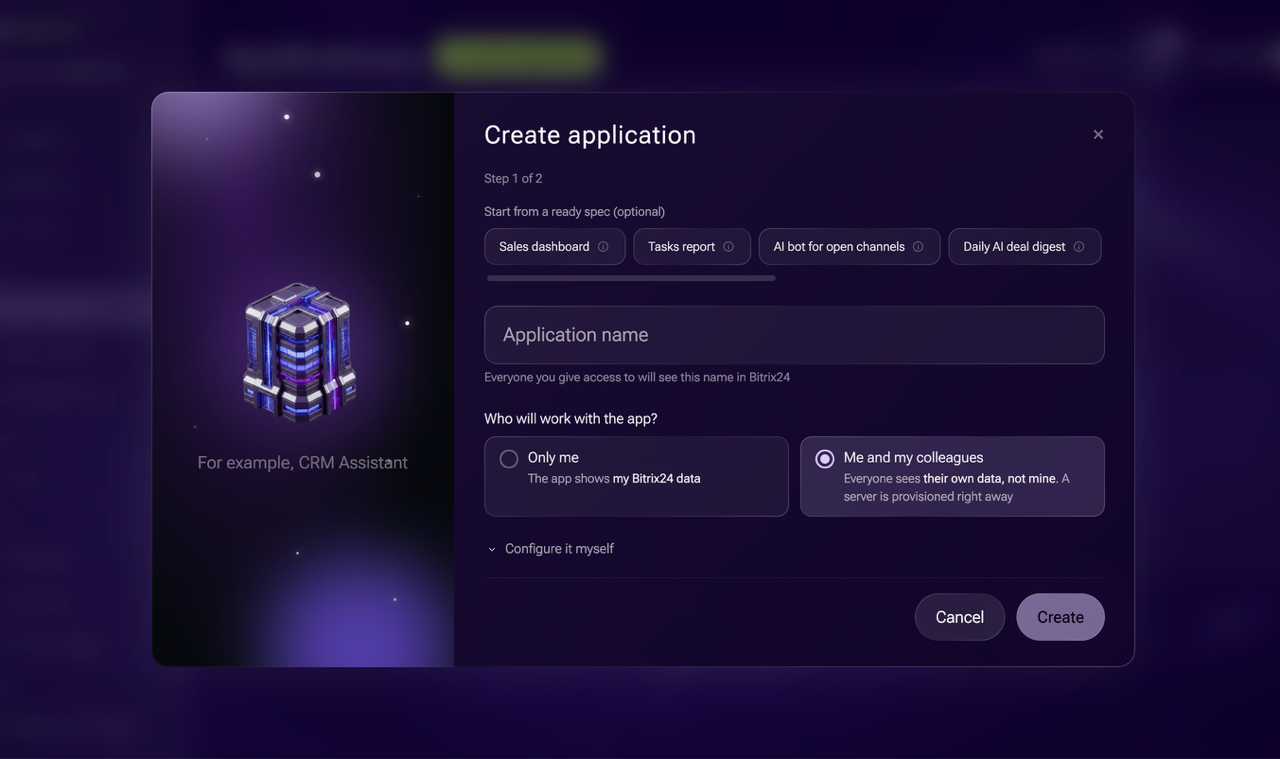 Alaio Vibecode turns software development into a structured, four-phase process:
Step 1: Identify a high-friction business workflow
Focus on repetitive operational tasks with clear inputs and rules, such as lead qualification, support ticket routing, contract checks, and executive reporting.
Step 2: Describe the logic using built-in prompt patterns
Instead of writing complex code, managers describe business logic in plain English or select from Alaio Vibecode’s prompt patterns. Domain experts can leverage no code ai tools for custom software to define workflows, while developers review edge cases.
- Example Prompt: “Build a custom app that analyzes incoming CRM leads in Bitrix24, ranks them by deal size and engagement history, updates lead stages, and alerts sales managers on high-priority deals.”
Step 3: Connect directly to Bitrix24 CRM data
Alaio Vibecode maps natural-language requests to Bitrix24 system actions under scoped permissions. This brings secure AI vibe coding directly into enterprise workflows and simplifies custom AI agent development for CRM tasks, all without exposing raw database credentials.
Step 4: Deploy securely in isolated execution environments
Building custom business apps with AI requires controlled execution. Backend scripts run inside secure sandboxed environments with Vibecode tunnels. Applications remain fully maintainable over time with built-in source versioning for auditing and instant rollbacks.
Building custom business apps with AI
In practice, enterprise teams leverage Alaio Vibecode to transform high-friction operations into autonomous workflows. Customer support teams can deploy custom AI agents directly within Bitrix24 open channels to analyze incoming inquiries, deflect routine tickets using knowledge base matching, and route complex escalations to live dashboards. Similarly, sales operations can replace rigid lead-scoring models with tailored algorithms that continuously monitor CRM deal activity, dynamically adjust win probabilities, and surface real-time summaries for leadership.
Legal and procurement departments extend these capabilities to document processing by launching contract review agents that scan uploaded files, flag compliance risks, and extract key financial terms to trigger automated approval workflows.
Because all these applications execute within the Bitrix24 workspace under strict zero-data retention policies, organizations can continuously expand their internal AI toolkit without compromising governance or security.
Enterprise governance & security: Why IT trusts Alaio Vibecode
Building custom business apps with AI should never mean compromising data protection. Alaio Vibecode provides IT directors with complete control:
- Scope permissions at a granular level, ensuring generated apps interact strictly with the specific Bitrix24 entities needed for the task.
- Isolate workspace memory and storage within sandboxed environments to eliminate any risk of cross-account data leakage.
- Maintain full lifecycle auditability with detailed logs tracking prompt histories, code revisions, and deployment events.
As a dedicated enterprise AI app builder, Alaio Vibecode transforms vibe coding from an unmanaged trend into a secure corporate advantage.
Frequently asked questions (FAQ)
What is vibe coding in simple terms?
Vibe coding means describing software functionality in natural language and letting AI generate and refine the code. In business, it accelerates the creation of custom internal apps, workflow automations, and AI agents.
Is vibe coding secure for enterprise CRM data?
It is secure when built within an integrated enterprise platform like Alaio Vibecode. Unlike standalone AI code generators that expose API keys, Alaio Vibecode executes apps inside isolated servers with scoped permissions and zero-data retention.
How does Alaio Vibecode differ from general LLM code generators?
General LLM tools only produce raw code. Alaio Vibecode provides a complete enterprise AI app builder environment, combining natural-language development, native Bitrix24 REST API access, managed hosting, AI model access, and version control.
Can non-technical employees build apps using Alaio Vibecode?
Yes. Domain experts can create functional tools using natural-language prompts and pre-built templates. IT teams maintain oversight through permission management and execution sandboxes.
The strategic takeaway: From prompts to production
Vibe coding is fundamentally shifting how business software is created. However, true operational value comes not from generating standalone code snippets faster, but from deploying governed, secure applications that connect natively to daily CRM workflows.
By combining prompt-driven creation with scoped permissions and isolated workspace infrastructure, Alaio Vibecode by Bitrix24 provides a practical path to turn natural-language ideas into production-ready internal tools without compromising enterprise security.