Workflow data is becoming an AI product question

Sponsored content prepared with SourceX
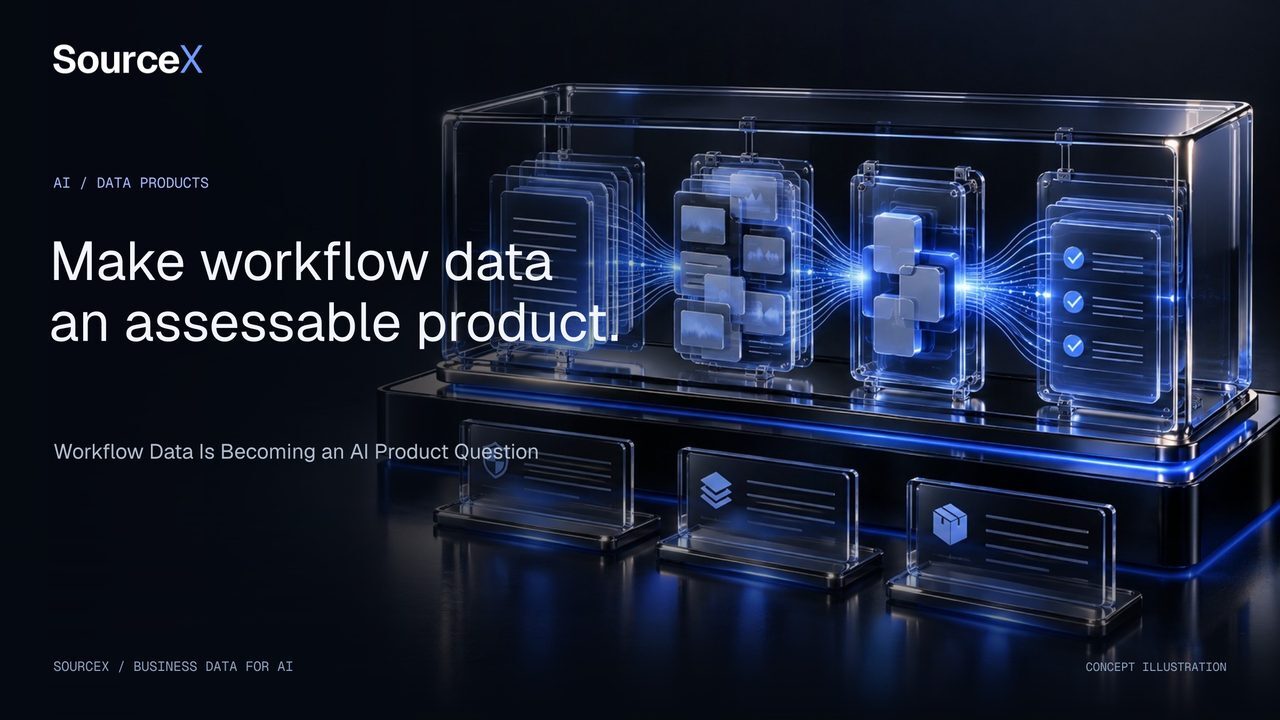 A record of work becomes much more interesting when someone can explain the decision inside it. The request arrived with incomplete information. A person checked a constraint, selected an action and verified an outcome.
That sequence can matter to an AI developer trying to train or evaluate a system on a similar task. It also creates a product question for the company that holds the record: what exactly could this collection support, and what rights would an approved user receive?
Calling the archive proprietary is only the start of the answer.
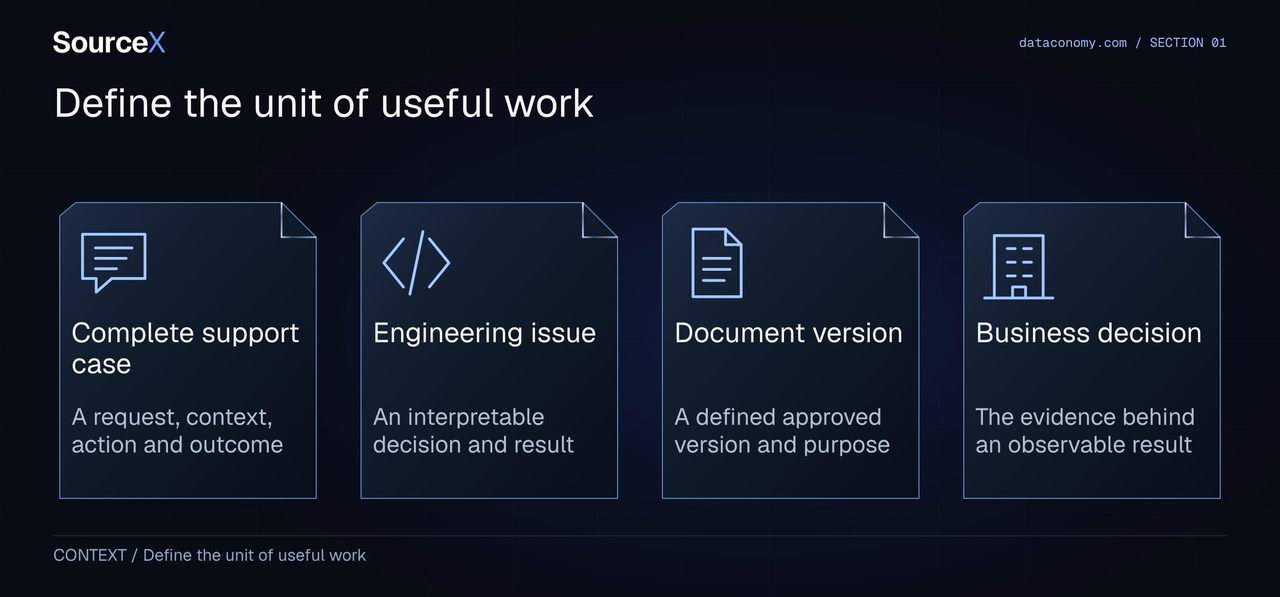
Define the unit of useful work
For some purposes, the useful unit is a complete support case. For others, it might be an engineering issue, an approved document revision or a business decision with an observable result.
 The unit needs enough context to be interpreted. A message can reference a policy, an earlier action or a separate system. If those relationships disappear, the example may no longer explain the task.
This does not mean every possible detail should be included. A proposed collection should retain the context needed for the approved use while excluding unnecessary or restricted information. Sometimes those requirements cannot be reconciled, and the example should be left out.
Gartner’s August 2026 research summary on agent-ready data says data leaders need to assess whether enterprise data and management practices support agentic requirements, including valid use of data. Its focus is enterprise readiness. The related product question is whether a proposed dataset makes its purpose, permissions and limitations inspectable.
Write the dataset description before the sales story
A credible description should state the task domain, the records included, the coverage period and the relationships preserved. It should explain how outcomes were determined and where they remain uncertain.
Illustration — Write the dataset description before the sales story.
For a hypothetical support collection, that could mean distinguishing verified resolutions from abandoned or merged cases. For engineering records, it could mean explaining whether a merged change was later reverted. The outcome definition affects what someone can learn from the collection.
Known gaps belong in the description too. Missing attachments, undocumented policy changes and inconsistent timestamps can influence a developer’s interpretation. Preparation should make those limitations visible rather than replacing them with a general quality claim.
Separate three product decisions
First, define the proposed use. Training, evaluation and retrieval are different activities. Permission for one should not be assumed to include the others.
Illustration — Three product decisions shape the collection. A narrower documented proposal may be more workable than an uncertain expansive one.
Second, establish the scope of the permitted material. A company may hold customer information, employee records or third-party content that it cannot freely license. The approved collection may be narrower than the underlying archive.
Third, define acceptance. A buyer needs to know what will be delivered and how it will be assessed. The supplier needs to understand the compensation and obligations. These details belong in the agreements rather than in assumptions drawn from a marketing headline.
Each decision can change the shape of the product. A narrower license with clear documentation may be more workable than an expansive proposal whose rights remain uncertain.
Evaluate the evidence rather than the file count
An archive may contain many repeated versions of essentially the same event. Another may overrepresent a small set of customers or successful outcomes. A useful assessment examines whether the collection supports the intended task without overstating its coverage.
Illustration — A larger file count can hide a weaker test. Review related examples across development and evaluation. No one universal format or split is assumed.
For evaluation, review contamination and leakage. Related examples should not accidentally make the test familiar. Context available only after the decision should not appear in an earlier task prompt.
These are examples of questions a preparation team can investigate, not a claim that one universal format or split is correct for every application.
A commercial route for approved records
SourceX pays qualifying businesses to license approved operational data for AI training and evaluation. It manages agreements, preparation, delivery and payout. The company approves the scope and use under the relevant terms.
Illustration — Turn an indistinct archive into an assessable proposal. SourceX manages approved licensing transactions. Referral rewards require the qualifying transaction and payment conditions.
Its company sourcing criteria include at least 50 full-time employees at peak, supported geography and suitable rights. The collection still needs to fit buyer requirements. Eligibility is a review process, not a consequence of owning a large archive.
Advisors and operators who know a potential supplier can explore the SourceX referral program. Eligible partners receive a default 25% of actual supplier compensation SourceX pays, capped cumulatively at $100,000 per company under the program terms.
The reward requires a qualifying transaction and the required buyer acceptance, cleared payment, supplier payment, finance approval and partner details. A lead alone does not trigger payment, and signed agreements may set different terms. Begin with an authorized company leader and a descriptive introduction, without forwarding raw records.
A workflow collection becomes easier to evaluate when its useful unit, permitted use and outcome definitions are clear. Those decisions turn an indistinct archive into a specific proposal a company and a buyer can assess.
About the Founder
Noah Loul is the founder of SourceX, helping businesses monetize their proprietary data autonomously for AI training and development. His ambition is to build the world’s largest data infrastructure, powering today’s AI and tomorrow’s superintelligence.
Sponsored image credit – Image credits: SourceX

Further reading

Nvidia unveils 120B-parameter Nemotron Super VL

US bans DeepSeek AI from civilian government systems