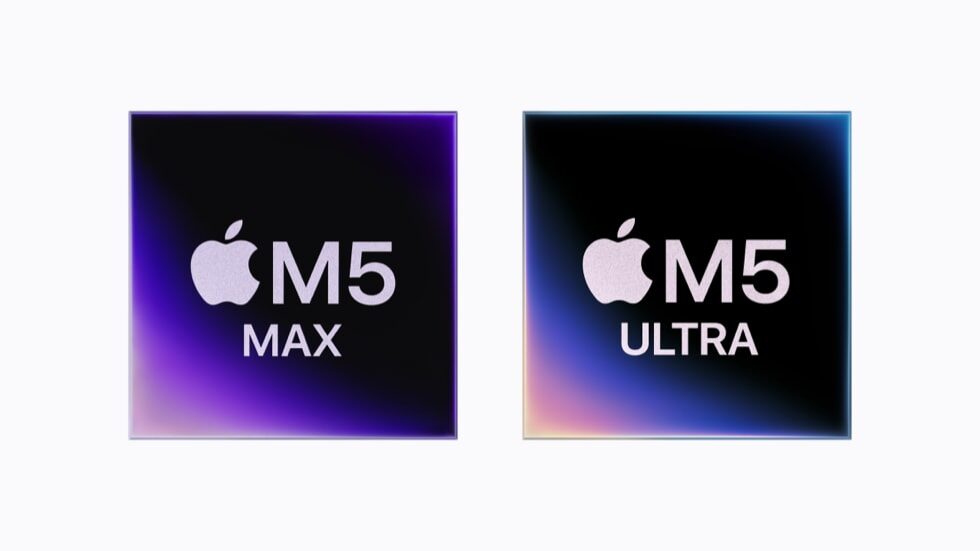
Apple has launched the M5 Ultra chip for the latest Mac Studio, with the new system starting at $5,499 for a 96GB configuration, up from $3,999 for the base M3 Ultra model at launch.
The M5 Ultra succeeds the M3 Ultra as Apple’s top Mac chip and uses a new quad-die design that combines two dual-die M5 Max chips through the company’s Ultrafusion bridge technology.
Apple said the new architecture increases connection density sixfold versus the M3 Ultra and raises interconnection speed to 4.4 terabytes per second from 2.5 terabytes per second.
The top M5 Ultra configuration has up to 36 processing cores, compared with 32 on the M3 Ultra. Apple said that includes 12 super cores and 24 performance cores, versus 24 performance cores and eight efficiency cores on the earlier chip.
Apple said the M5 Ultra delivers 25% faster single-threaded performance and up to 30% faster multithreaded performance than the M3 Ultra.
Both chips support up to 512GB of unified memory, but the M5 Ultra lifts memory bandwidth by 50% to 1.2TB/s. Apple said that would allow users to keep large datasets in local memory and run large language models with hundreds of billions of parameters on device.
The 512GB version is due in October and is expected to cost about $15,000.
The M5 Ultra and M3 Ultra both have 80 GPU cores, but Apple said the newer chip uses redesigned cores with a Neural Accelerator in each core that can raise AI compute speeds by up to 4.5 times.
Apple said the GPU also adds second-generation Dynamic Caching, hardware-accelerated mesh shading and third-generation ray tracing, producing up to a 40% speed increase over the M3 Ultra.
The updated Media Engine includes four ProRes encode and decode engines, along with hardware acceleration for AV1, H.264 and HEVC. Apple said the chip can play 33 streams of 8K 30 fps ProRes video at once, compared with 24 on the M3 Ultra.
The M5 Ultra supports Thunderbolt 5 speeds of 120Gbps and moves to PCIe Gen 6 internal SSD architecture from PCIe Gen 5. Apple said supported x16 lane devices can reach speeds of up to 128GB/s.
Apple cited several workload gains against the M3 Ultra, including up to 3.3 times faster CopyCat ML training in Foundry Nuke, up to four times faster LLM prompt processing in LM Studio, up to 4.3 times faster text-to-image LLM performance, and up to 1.7 times faster scene rendering in Maxon Redshift.
The M5 Ultra is built on TSMC’s third-generation 3-nanometer process, while the M3 Ultra uses TSMC’s first-generation 3nm process.
Featured image credit