Bitcoin (BTC) is currently trapped in a fragile consolidation zone, analysts argue. This is a result of waning demand and continuous ETF outflows. Additionally, it’s heavily affected by intensifying macro uncertainty, geopolitical tensions, and policy indecision.
Moreover, the price has failed to break key resistance levels, and investors across the board are moving into risk-off mode, putting funds into traditional safe-haven metals.
Analysts note that the upcoming days are key for the mid-term market performance. Thin liquidity, cautious institutional positioning, and headline-driven volatility are all increasing the risk of this consolidation phase shifting into a broader bearish trend.
‘Consolidation Will Prevail’
According to the latest Bitfinex report, Bitcoin’s attempt to break higher has stalled. The coin failed to stay above the $95,000–$98,000 resistance zone. Instead, it went right back into its established range.
It hit a high of $97,850 in mid-January, posting a double-digit drop since below the yearly open. This follows weakened buying momentum and higher exchange-traded fund (ETF) outflows.
The analysts argue that “the rejection of any upward gains has taken place near the short-term holder cost basis, highlighting a fragile equilibrium, where downside continues to be absorbed but upside progress is consistently met by distribution from prior-cycle buyers.”
Moreover, if ETF demand remains low, Bitcoin will likely stay range-bound. Consolidation will “prevail until a clearer demand catalyst emerges.”
Market volatility suggests “event-driven caution rather than a broader regime shift,” Bitfinex says.
Meanwhile, geopolitical uncertainty contributes to volatility, especially the US-driven escalations. Tariff threats resulted in a brief risk-off response across equities, with volatility jumping, but “the rapid pullback in policy rhetoric restored near-term stability.”
The report concludes that investor positioning “suggests that markets view recent rebounds as stabilisation rather than a return to expansionary conditions.”
Crypto market depth stayed thin. Spot bitcoin ETFs barely drew fresh money after heavy redemptions last week, and derivatives positioning eased, a combination that has kept traders leaning toward short-term ranges rather than big directional bets.
Equities sent a mixed signal across…
‘Teetering In the Grip of Bearish Sentiment’
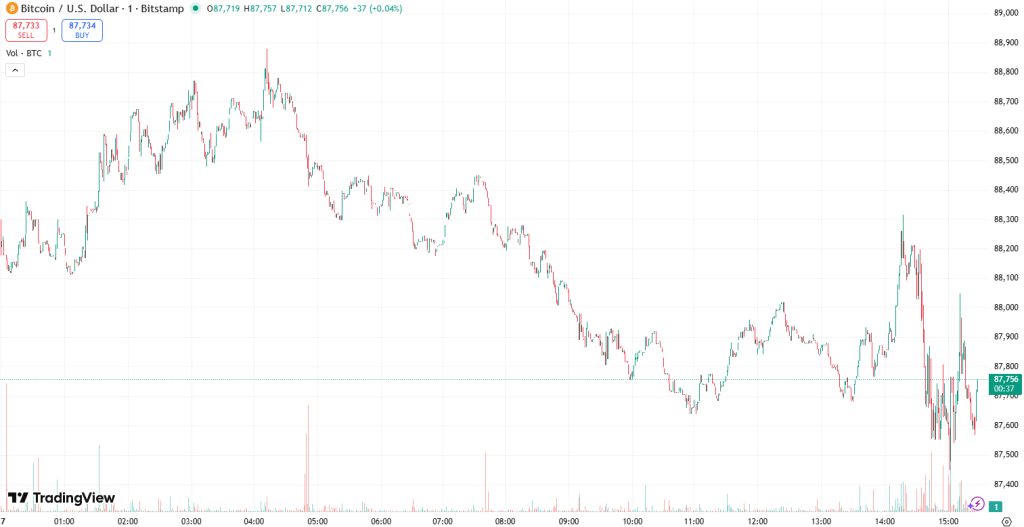
Petr Kozyakov, co-founder and CEO at Mercuryo, commented that BTC “stands precariously” at about $87,000. It currently “continues to teeter in the grip of bearish sentiment.” As the week began, it fell to the $86,100 level in “frenetic Asian trading.”
Markets are in risk-off mode as gold and silver surge. This shows that investors are “rushing to traditional safe-haven assets amid increasing levels of geopolitical risk.”
Additionally, both retail and institutional crypto investors remain on the defensive, Kozyakov added. Retail-driven sectors and institutional participation have retreated.
Moreover, Nic Puckrin, investment analyst and co-founder of Coin Bureau, writes that gold and silver are in “uncharted territory now.” While predicting prices is hard, the surge currently “shows no weakness.” The macro picture supports a risk-off environment for gold to shine.
As gold posted all-time highs, the US dollar posted a 15.6% drop from the 2022 peak. This is its biggest decrease in history, Puckrin notes.
At the same time, “Bitcoin and digital assets continue to lag, despite the return of dollar debasement fears.”
Bitcoin ETFs have seen $1.7 billion of outflows. Even if surveys show optimism among institutional investors, at least in the long term, many from this group also argue that we have entered a bear market.
“The longer Bitcoin remains under $100,000, the more momentum will trend to the downside,” Puckrin says.
The chart looks weak, and BTC may move to the $92,000 level in the short term.
“While a new all-time high this year still isn’t out of the question, the next 30 days will be crucial in determining whether a bear market is already here,” the analyst says.
Historically, certain external catalysts would lead to crypto price breakouts. For example, a similar decrease in 2017 prompted a historic bull market. However, there are now fewer such catalysts. This is the result of the “ongoing macro uncertainty, fears over another US government shutdown, and prevailing expectations of a rate cut pause from the Federal Reserve,” Puckrin concluded.
Over the past 24 hours, Bitcoin has remained mostly unchanged by the time of writing (Thursday afternoon, UTC). It has gone up by just 0.2%, currently trading at $89,582.
Earlier in the day, it saw a notable drop to the $87,300 level, before climbing to the briefly…
‘Hope For an Aggressive 2026 Easing Cycle Has Cooled’
Jimmy Xue, co-founder and COO of Axis, argued that Bitcoin’s $90,000 pause is a “macro repricing, not a demand breakdown.”
More precisely, the current pause is a macro-driven repricing of the discount rate, Xue says, as “the market’s hope for an aggressive 2026 easing cycle has significantly cooled.”
The spot ETF inflows remain a resilient floor, he says. But they are currently acting as a “passive wall” and not an active engine of price discovery.

Per Xue, “the $90,000 level has become a psychological battleground where macro traders are taking profits to hedge against a restrictive Fed, even as long-term institutional accumulators continue to buy the dips.”
He concludes that “a signal of Fed ‘patience’ this week effectively removes the immediate liquidity injection the market was front-running, leading to a period of ‘tense calm.’”
Therefore, a lack of fresh capital “in an environment already shaped by geopolitical friction and trade uncertainty” commonly triggers ‘volatility by headline.’ Thin order books lead to sharper, news-driven price swings, Xue writes.
“Without a dovish pivot, expect liquidity to remain defensive and concentrated in the most established assets,” he says.
BTC must compete on its merits as a structural hedge instead of “a high-beta liquidity sponge.” Xue concludes that “this higher hurdle rate for capital means that the ‘easy’ institutional gains of 2025 are likely to be replaced by a more selective, value-driven growth phase.”
The crypto market posted a notable increase last week, but dipped over the weekend and started this week lower.
Looking at BTC, over the past 24 hours, it dropped from the intraday high of $95,467 to the low of $92,263. At the time of…
‘Current Bitcoin Range Is a Fragile Truce’
Samer Hasn, senior market analyst at XS.com, said that Bitcoin saw a brief increase, but one that “lacks conviction and feels more like a pause than a restart.”
The analyst pointed out several significant, interwoven factors influencing the market at the moment.
The first is the overall liquidity shrinking. Spot ETFs have been recording mostly outflows over the past week, crypto futures open interest fell to $128 billion, and Bitcoin futures dropped to about $58 billion.
At the same time, whales are still accumulating coins. The whale addresses holding between 1,000 and 10,000 BTC reached 1,955 as of Sunday, almost the highest level since November.
“That combination matters because liquidity is the fuel for any sustainable rally. When upward moves arrive on thin demand, they tend to be reversed violently if a catalyst spooks markets.”
Moreover, Bitcoin’s hashrate plunged following a massive storm in the US, with major mining companies halting operations due to disruptions and surging prices. “If these mining firms are forced to liquidate their Bitcoin holdings to cover fixed operating costs during the downtime, it may exert significant downward pressure on prices amidst already tight liquidity,” Hasn writes.
Finally, the incoming US Fed meeting, political shocks, and geopolitical escalations threaten the market as well.
“In short, Bitcoin’s current range is a fragile truce,” Hasn argues. “Durable upside needs steady spot demand, calmer funding conditions and a clear fade of the event risks that are currently shrinking liquidity and shortening traders’ time horizons.”
The post Bitcoin Is Stuck in Fragile Consolidation as Markets Turn Risk-Off and Bearish Signals Build Up, Analysts Say appeared first on Cryptonews.